
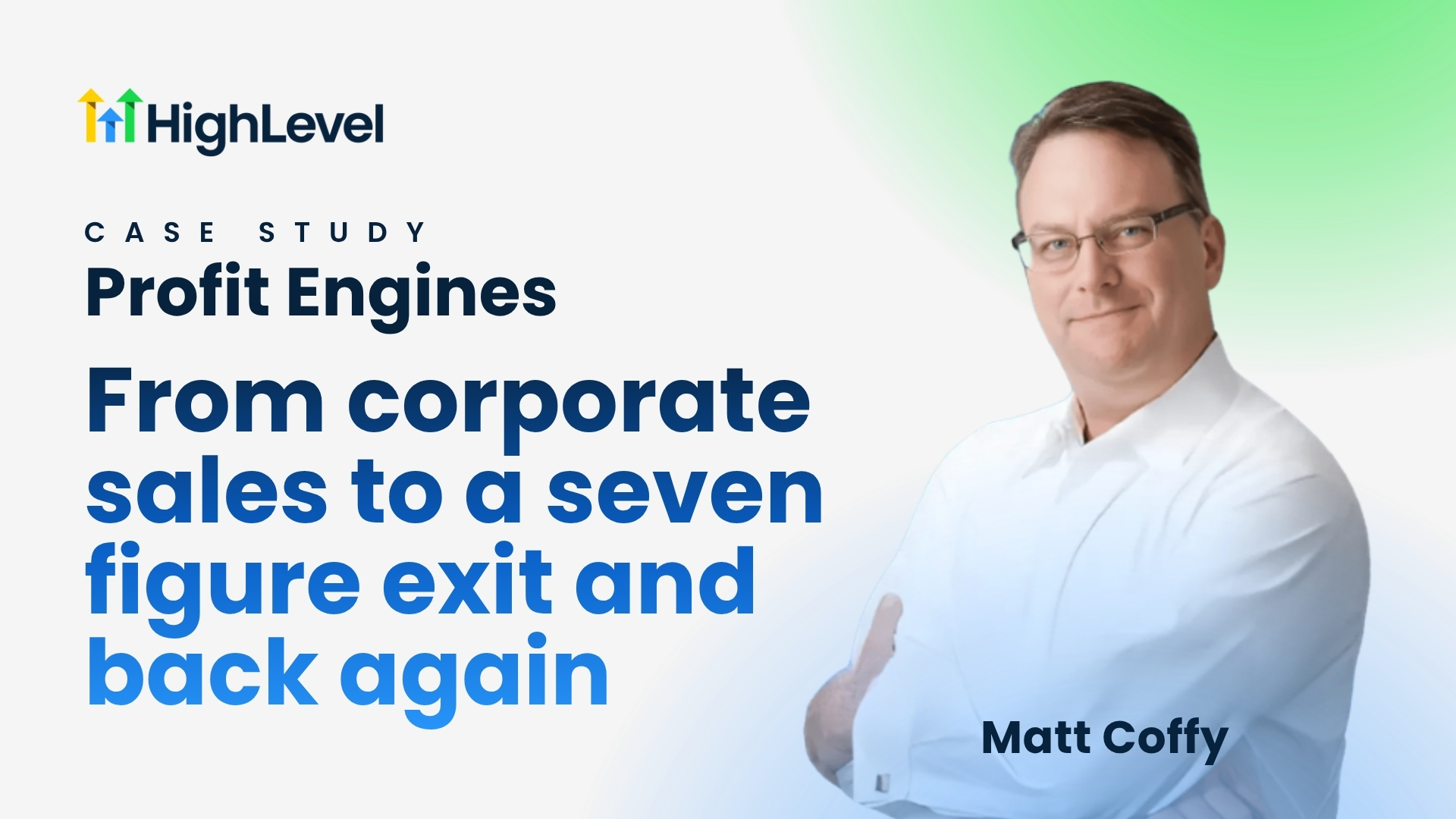
From corporate sales to a seven-figure exit and back again: How Matt Coffy rebuilt a HighLevel business from scratch… twice
Note: This case study reflects one user's experience. Results vary and are not typical.
In 2010, Matt Coffy had no plan. He'd spent six years at Sprint as one of the top salespeople in the company, taken the trips, hit the numbers and still walked away.
"The corporate ladder never interested me," he says.
No funding. No niche. No idea what the business would even be. He just knew he couldn't stay.
His first client was his dentist. He'd walk into local businesses within twenty miles of his office and offer to lower their phone bills.
That turned into websites. Then logos. Then signs for the sides of buildings.
In 2011, he hired cold callers out of a local prison work-release program to book him meetings. He didn't always know what they said on the phone. He just knew he ended up in the room.
That room-by-room hustle became a company. Then it became two companies, one of which he sold in 2024, before starting over with almost nothing, on purpose.
The challenge: Starting from scratch after selling a business built on 14 years of work
By 2024, the agency Matt built (Customer Bloom, then AgencyBloom, then PracticeBloom) was a multi-million dollar operation serving spine surgeons, chiropractors, physical therapists and med spas, running 30 to 40 new clients a month through Facebook ads and HighLevel.
It made the Inc. 5000 fastest-growing list in 2023.
Then Matt sold it.
The sale agreement let him keep a small seed group of clients and a couple of employees who wanted to stay. Everyone else, and every system built over fourteen years, went with the buyer.
"After I sold the business, I had no more customers, so I had to start over," Matt says.
What he kept could not have supported a company on its own. He had consulting instincts, a short client list and a name for the new venture: ProfitEngines.
Everything else had to be rebuilt from a standing start, in a market that had shifted underneath him.
AI voice, AI chat and agentic bots were suddenly what businesses wanted to buy, and Matt had none of it built yet.
Starting an agency once with nothing is a story. Doing it twice, at a point in a career where most operators are coasting on what they already built, is a different kind of pressure entirely.
The solution: Build in modular pieces, lead with content and let AI do what the old agency needed thirty employees to do
Matt didn't rebuild the old model. He built a narrower one that could scale without the headcount his last agency needed to run.
The foundation is what he calls the Content OS: hundreds of pieces of content produced monthly, for ProfitEngines and for clients.
"We produce hundreds of pieces of content monthly, for ourselves and for clients, because that's what's selling today," Matt says.
He built it around what he calls the three-L system.
"People want to be found and legitimized," he says. "We call it the three-L system: leads, legitimize and legacy."
Clients who once resisted showing up on camera now ask for more of it once they see themselves referenced on TikTok, YouTube and Facebook.
On top of that, ProfitEngines sells in modular pieces instead of one full-service package:
Chatbot services, priced at $199 a month
Facebook ads plus HighLevel management, at $499 a month
Facebook and Google ads plus HighLevel, at $899 a month
SEO, at $500 a month
The Content OS and social media system, at $1,500 a month
Clients add pieces as they need them.
A light engagement runs around $1,500 a month.
A client running the full stack, content, ads, AI voice and text, plus a small call center, can run up to $5,000 a month.
Matt builds it in stages: start with content, add the CRM, add AI through platforms like Assistable or HighLevel depending on complexity, add ads, add the call center if the client wants it.
The acquisition engine is just as stripped down:
Referral relationships carried over from the old business
Re-engaging past clients on new strategies
Direct cold calling and outreach targeted specifically at businesses that want AI lead generation.
All driven by the same room-by-room instinct that built the first agency, aimed at a narrower, higher-leverage offer.
The result: A client taken from losing $10,000 a month to profiting $100,000 a month, a rebuilt business near half a million in year one and a new kind of client altogether
The clearest proof point isn't ProfitEngines' own revenue. It's what the model did for one client.
"I've helped one of our clients go from a negative $10,000 per month profitability to over $100,000 a month in profitability over a course of 8 months," Matt says. "We increased their revenue from 100,000 to 500,000 a month at the same time."
ProfitEngines itself has grown to 30 active clients on recurring services plus 30 additional web hosting clients, generating roughly $40,000 a month in recurring revenue less than a year and a half after starting from the seed group Matt kept in the sale.
And the client roster has changed shape entirely. ProfitEngines is now working with a VC-funded group operating 50 locations, building out AI voice and chat and wiring it into the group's internal systems, a scale and type of engagement the old med-spa-focused agency never touched.
Matt has been on HighLevel since customer number 111, dating back to when he moved his entire tech stack, ActiveCampaign, CallRail and everything else, onto one platform around 2018 to 2019.
That early bet on consolidation is the same instinct now driving the next one: fewer moving parts, more leverage per client, less labor required to run it.
What happens when you rebuild an agency around AI instead of headcount?
Matt Coffy didn't repeat what worked the first time. He built a leaner version on purpose, trading thirty employees and a full-service model for a modular offer, a content engine and AI doing work that used to require a call center.
Less than a year and a half after starting over with a handful of clients, Matt is running a rebuilt business generating roughly $40,000 a month in recurring revenue, working with a 50-location VC-backed group on AI voice and chat, and actively looking to acquire another agency to compress the next stage of growth.
"I'd like to go from about half a million to a million next year," he says.
Read the full case study to see how the modular pricing model works tier by tier, how the three-L content system turns skeptical clients into repeat referral sources and how Matt is evaluating which agency to acquire next to reach seven figures faster.
Disclaimer: The results shared in this case study reflect the experience of one HighLevel user and are not typical or representative of what other users may achieve. ProfitEngines' growth and revenue outcomes are specific to their unique business model, market and execution. Revenue figures represent gross revenue during the stated period and do not reflect expenses or net profit. HighLevel makes no representations, warranties or guarantees regarding potential earnings, client growth or business success. This content is for illustrative and informational purposes only and does not constitute a business opportunity, franchise offering or earnings guarantee. Past performance does not predict future results and individual results will vary significantly.